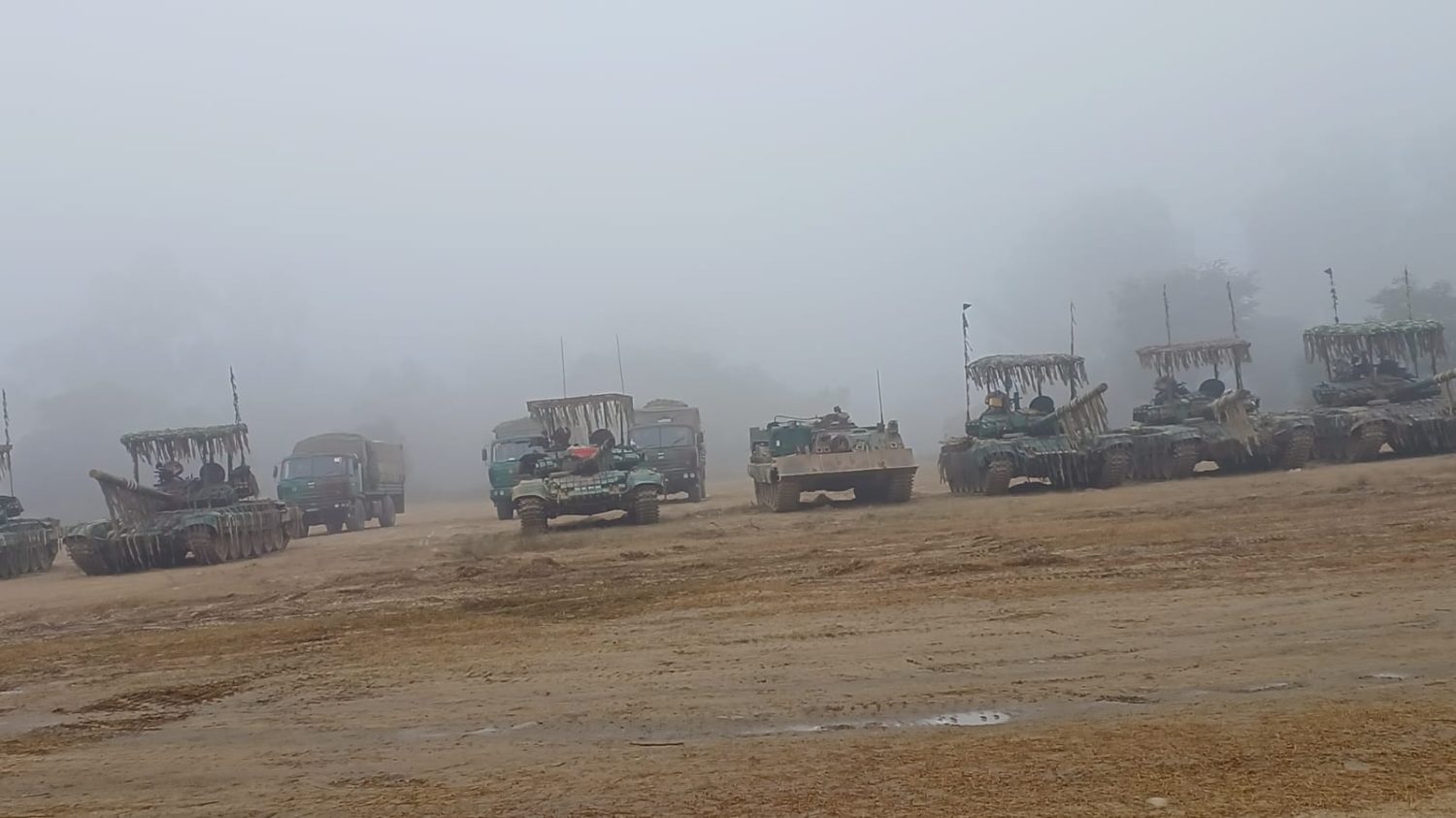
Tactical mesh comms for tanks, troops & paratroopers.
From an APC moving in a column, to a stick of paratroopers in free-fall, to a section clearing a building — Meshtastic India builds purpose-fit kits that go where MANET, satcom and cellular cannot follow. ATAK-integrated, AES-256 encrypted and key-rolled — custom built to your requirement and your licensed band, in weeks rather than a development programme.
Built to the band you are licensed for.
Off-the-shelf mesh radios ship locked to the licence-exempt default. If your organisation holds its own frequency allocation, we build to that instead — band, channel plan and output set to what your licence actually permits, configured before the kit ships.
Your Licensed Band
Built to the sub-GHz allocation you hold, rather than the licence-exempt default. You supply the allocation; we build and test the hardware to it.
Channel Plan
Channel spacing, dwell time and hop sequence defined to your requirement and fixed in firmware, so field units cannot drift off the assigned plan.
Output Within Limits
Transmit power and duty cycle set to your licence conditions — including amplified nodes and mast gateways where the link budget needs them and the licence allows.
Range or Throughput
Spreading factor and bandwidth tuned to your terrain — longer reach on thin data, or more data across shorter hops. Set per channel, not fixed at purchase.
Command Station
Fixed or vehicle-mounted control station on request — multi-channel monitoring, mapping and logging for the whole net in one place.
Documented Build
Every unit built to a written specification and supplied with its configuration and test data, so it can be checked against your own approvals.
We build to the allocation you already hold — obtaining and maintaining the licence remains yours. Send us the band, channel plan and power conditions and we will confirm what we can build against them.
Custom built to your requirement — without a development programme.
A bespoke radio programme is measured in years. Most requirements do not need one. We start from proven, in-production hardware and customise it — band, channel plan, power, form factor, mounting and integration — so what arrives is specific to you, but arrives in weeks.
That is the whole proposition: the fit of a custom build, at the lead time of a catalogue product. You describe the requirement; we configure, build, key and crate against it. Nothing waits on a new silicon spin, a new certification cycle or a new supply chain.
- Customised from hardware already in production — no development lead time
- Configuration, keying and ATAK loading done before dispatch, not on site
- Changes to band, channel plan or power handled in firmware, not in silicon
- Scales the same way from a section trial to a battalion order
- Follow-on units built to the identical, recorded configuration
Requirement
Band, channel plan, team size, terrain, platforms and what it has to mount to. A written spec comes back for you to confirm.
Configure & Build
Firmware, keying, mounts and integration built against that spec on hardware already in stock.
Key, Crate & Train
Pre-keyed to your mesh, ATAK loaded, crated to contents, and handed over with operator training.
Repeat Builds
The configuration is recorded, so the fiftieth unit is identical to the first and follow-on orders are quick.
What it adds to existing tactical comms.
Meshtastic is not a replacement for combat-net radio. It's a low-cost, low-signature, low-EMCON layer that runs alongside it — for blue-force tracking, silent text, and section-level coordination when voice is too loud or the primary net is down.
Low EMCON Signature
Sub-watt LoRa transmissions are short, frequency-hopped and statistically thin — far harder to DF than continuous voice on a combat net.
No Single Point
Lose any node — vehicle disabled, operator down, repeater destroyed — and the mesh re-routes within seconds. There is no headquarters node to take out.
ATAK-Native
GPS, chat, casualty markers and waypoints all flow into ATAK / iTAK / WinTAK. Operators see the whole section on a map without uplink.
AES-256 Channel Keying
Channels keyed before issue. Hardened "trooper" variants prevent in-field rotation so a captured device cannot be re-paired to a hostile mesh.
Persistent on a Charge
Rugged variants run 36–48 hr active. Solar repeaters and vehicle-power harnesses keep field nodes online for the duration of the operation.
Made in India
Hardware integrated, cased and keyed in our Greater Noida workshop. Repairs and spares supported domestically — no overseas RMA.
Five purpose-fit configurations.
Each kit is sized to a specific operational unit, with the right mounts, antennas, power systems and ATAK profiles preloaded.
Armoured Vehicle Kit (Kit-AV)
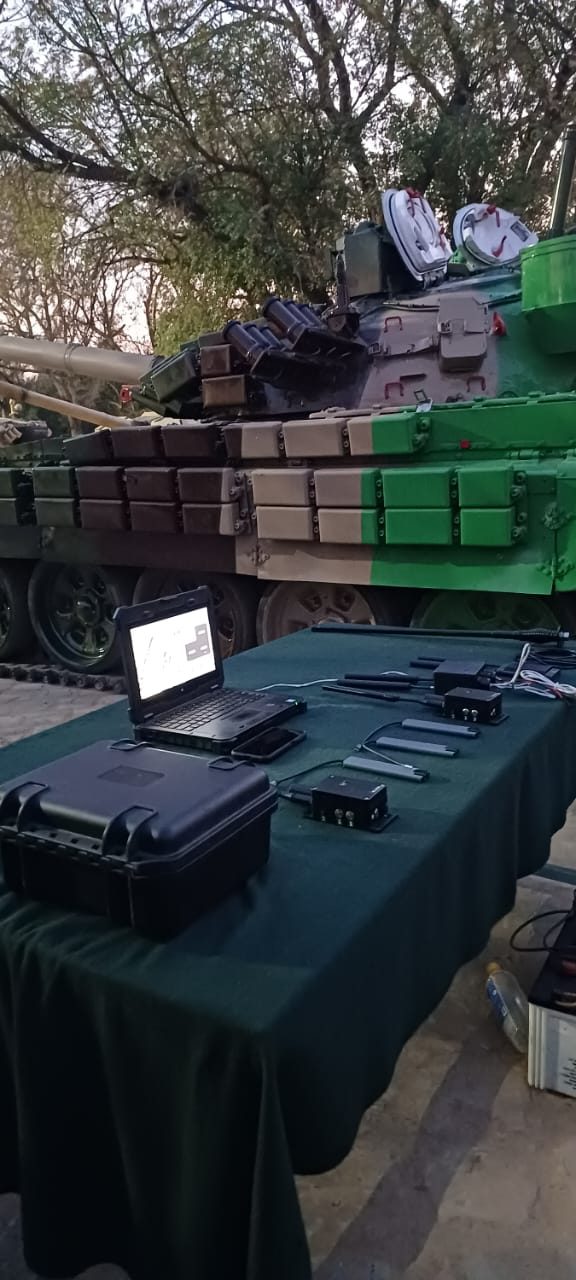
Tank, ICV and APC crew kit. A vehicle-powered mesh node with external roof antenna feeds an in-cabin command tablet. Crew dismounts carry trooper nodes that auto-pair to the vehicle on return.
- 1 × vehicle-mounted node, 24 V harness, surge-protected
- 1 × magnetic-mount external 5 dBi antenna
- 1 × 8" rugged in-cabin display, ATAK preloaded
- 4 × Trooper nodes for dismounted crew
- Hard-wired channel pair: vehicle-net + section-net
Airborne / Paratrooper Kit (Kit-AB)
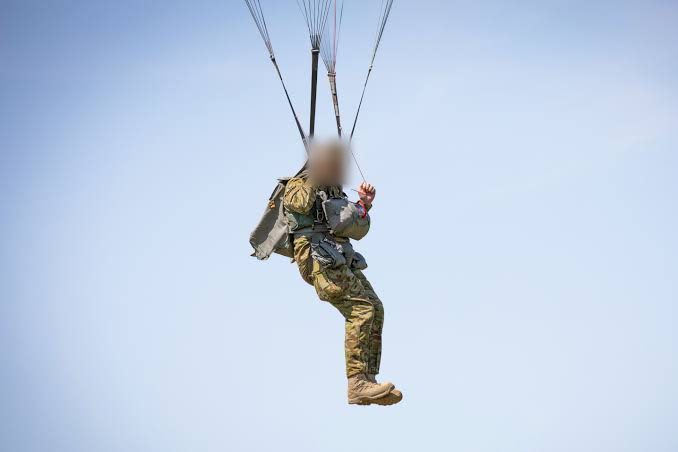
For static-line and free-fall sticks. Helmet-mounted Trooper nodes with magnetic charging form a self-rallying mesh in the drop zone — operators see each other's positions on EUD before they've even hit the ground.
- 12 × Trooper nodes, helmet-rail (ARC) mounted
- 12 × ATAK / iTAK preloaded EUD phones, chest-rig pouch
- Drop-tested for static-line + free-fall (30 G impact)
- "Rally" beacon mode: emit GPS for 2 hrs after landing
- Hardened keying — no in-field channel rotation
Infantry Section Kit (Kit-IS)
A self-contained mesh for a 10-person section, with the section commander as primary EUD and every soldier carrying a Rugged or Trooper node. Silent text, position pings and casualty markers — no voice required.
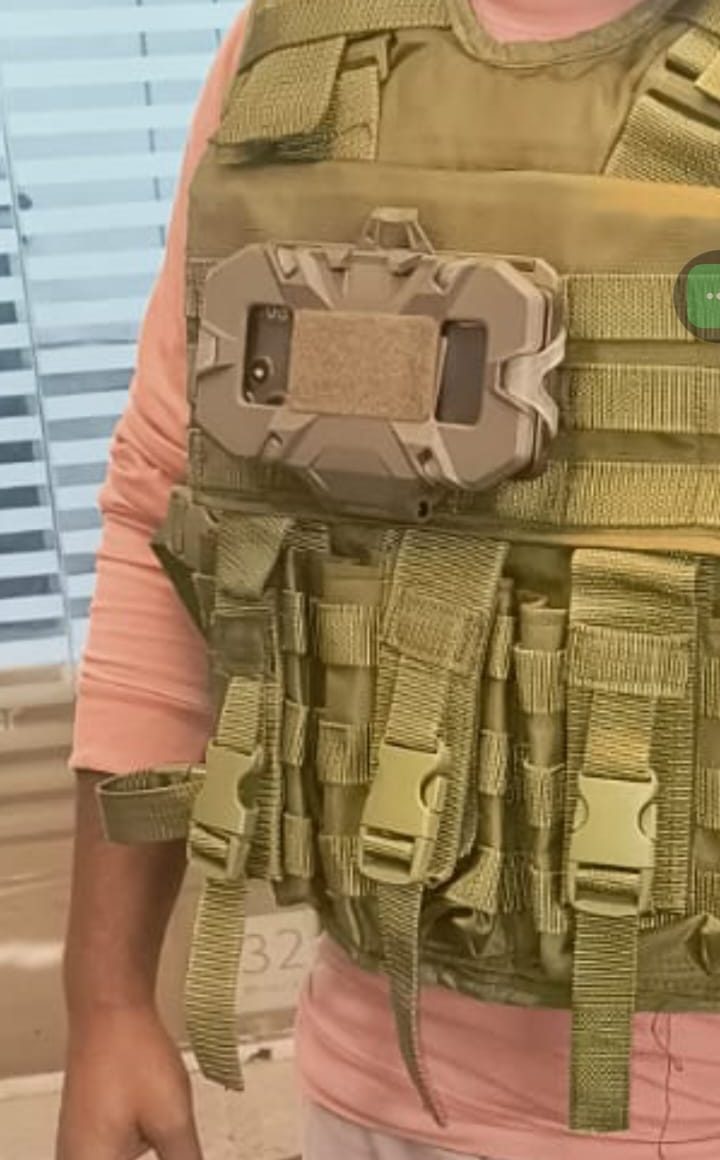
- 10 × Rugged Cased Devices, MOLLE-mounted
- 2 × ATAK EUD phones (commander + 2IC)
- 1 × portable solar repeater for static patrol bases
- Pre-built channel set: section + platoon + company nets
- Casualty ping + last-known-position messaging
Special Forces Kit (Kit-SF)
Minimum-signature variant — receive-mostly nodes, low-power TX profile, on-demand position emission. For deep-recce, raids and CSAR where every transmitted bit is a risk.
- 6 × low-profile Trooper nodes, glove-friendly buttons
- Receive-only "listen mode" with timed ping intervals
- Burst-position mode (compressed coords, sub-second TX)
- Encrypted callsign rotation — channels rotate on schedule
- Tamper switch — node wipes keys on enclosure breach
- Pre-deployment training included
Forward Base Kit (Kit-FB)
A persistent mesh for forward operating bases, border outposts and LP/OP. Mast gateway, perimeter sensor nodes and a command-post display turn the camp into a single situational awareness picture.
- 1 × mast-mount gateway with 8 dBi fibreglass antenna
- 6 × solar perimeter sensor nodes (PIR + GPS beacon)
- 1 × 14" command display with full ATAK installation
- Optional MQTT bridge to Brigade HQ over satcom or fibre
- Coverage 8–12 km radius typical (terrain-dependent)
Kit comparison.
Every kit below is a starting point, not a fixed SKU. Team size, band, mounting and integration are set to your requirement before the build starts.
| Kit-AV Armoured |
Kit-AB Airborne |
Kit-IS Infantry |
Kit-SF Special Forces |
Kit-FB Forward Base |
|
|---|---|---|---|---|---|
| Sized for | 3–4 crew | Stick up to 12 | 10 personnel | Team of 4–6 | Base + 6 sensors |
| Typical range | 10–25 km LOS | Drop-zone mesh | 5–15 km mesh | Team mesh | 8–12 km coverage |
| Power | Vehicle 12/24 V | Internal, 24 hr | Internal, 36–48 hr | Internal, low draw | Solar + base AC |
| Mounting | Roof antenna, in-cabin display | Helmet / carrier | Carrier / MOLLE | Low-profile carrier | Mast + perimeter |
| Ingress protection | IP65 in-cabin | IP67 | IP65 | IP67 | IP67 outdoor |
| ATAK / iTAK | Pre-installed | Pre-installed | Pre-installed | Pre-installed | Command display |
| Channel keying | Pre-keyed | Hardened, no field rotation | Pre-keyed | Hardened + key-wipe | Pre-keyed |
| Licensed band build | Available | Available | Available | Available | Available |
Figures are typical for the standard build. Range depends on terrain, antenna and the band you are licensed for — we will give you a link budget for your own ground rather than a headline number.
Every node, on every operator's map.
Each Meshtastic India device pairs over Bluetooth with an Android EUD running ATAK / iTAK / WinTAK. The Meshtastic plugin pushes GPS pings, chat messages, casualty markers and free-text waypoints directly onto the COP — visible to the section commander, platoon HQ and (if bridged) battalion.
We pre-install the plugin, set up channel-to-cot-server mappings, and load the area-of-operation map tiles before the kit ships. Operators see their team move on the map from minute one.
- Blue-force tracking with GPS pings every 30 s (configurable)
- Casualty / 9-line MEDEVAC markers
- Free-text chat by callsign or section
- Pre-loaded offline maps for your area of operations
- Optional CoT (Cursor on Target) bridge to higher echelons
Where mesh earns its keep.
Five realistic scenarios where a Meshtastic mesh either replaces or augments traditional tactical comms.
Silent Section Movement
Patrol moves with radios off. Mesh carries position + short text. Voice-net only used on contact.
FEBA / FOB Perimeter
Solar-powered sensor nodes ring the position. Sentries watch a single map; commanders see who tripped which fence.
Disaster-Aid Liaison
Forces deploying for HADR / IDR coordinate with civil authorities and NGOs on a shared mesh — even with all towers down.
Convoy / Column
Vehicles in a column auto-mesh on the move; lead and tail vehicles always know each other's position even in radio dead-zones.
Mountain Picket Net
High-altitude pickets relay each other's traffic over ridges where line-of-sight to base is impossible. The peaks become repeaters.
Combat-Net Backup
Primary tactical radio jammed or down? Mesh keeps section-level coordination alive while the signaller works the issue.
Trialled on armour, worn on the body, installed on the mast.
We do not hand over a carton and leave. Kits are integrated on the platform, worn and adjusted with the operators who will carry them, installed at the site, and handed over only after the unit has run the mesh themselves.
Armour
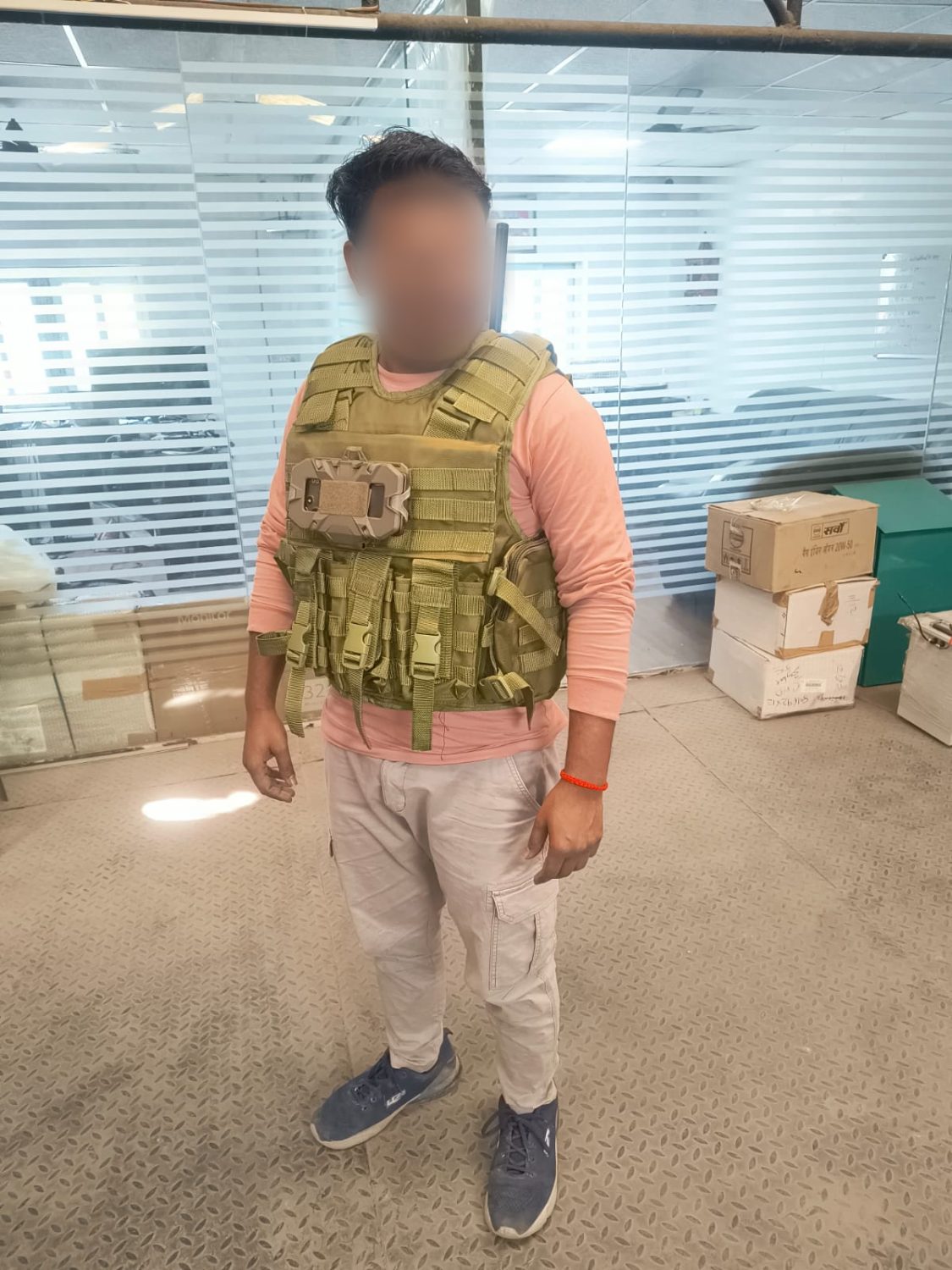 Worn Fit
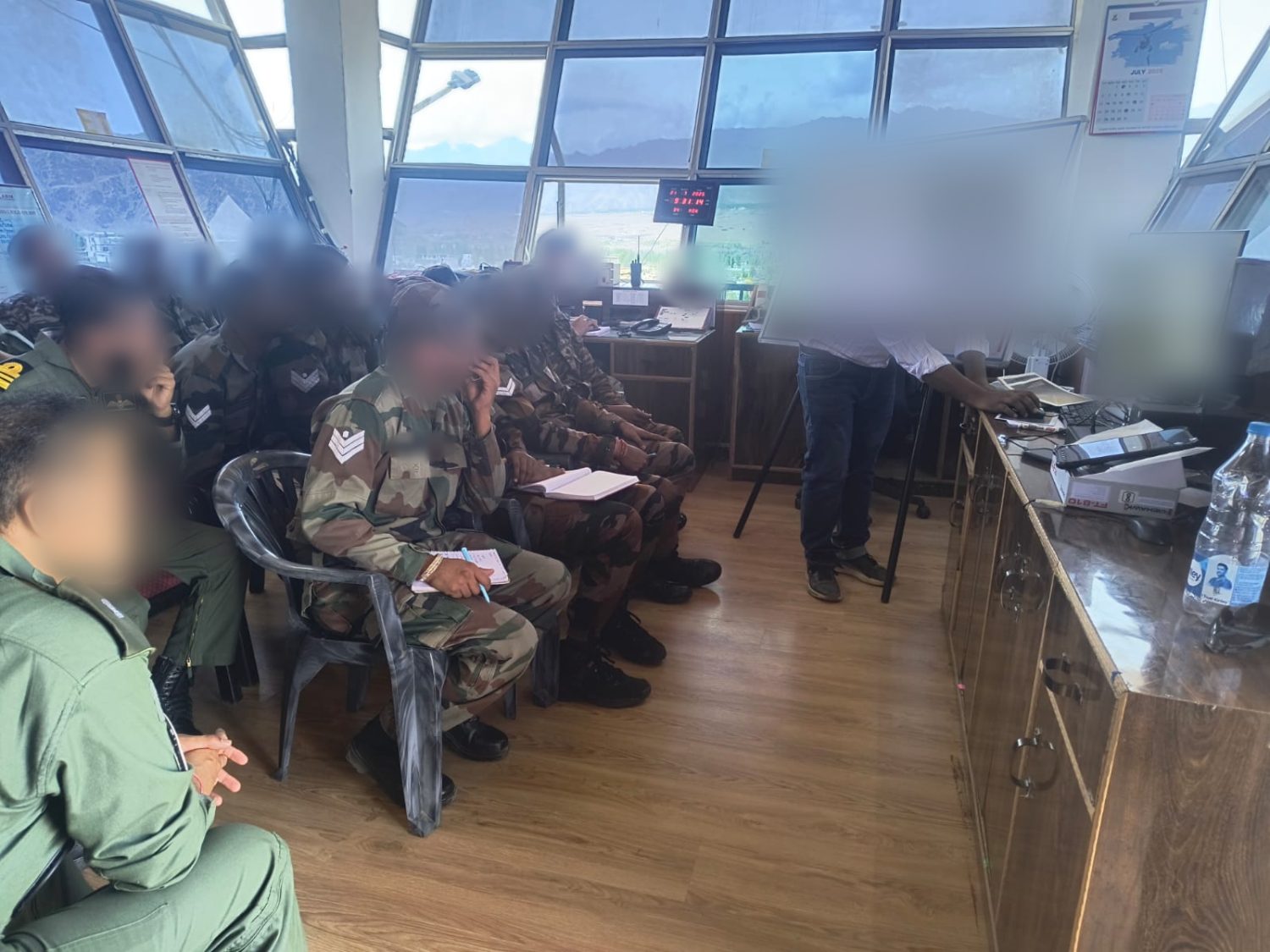 Training
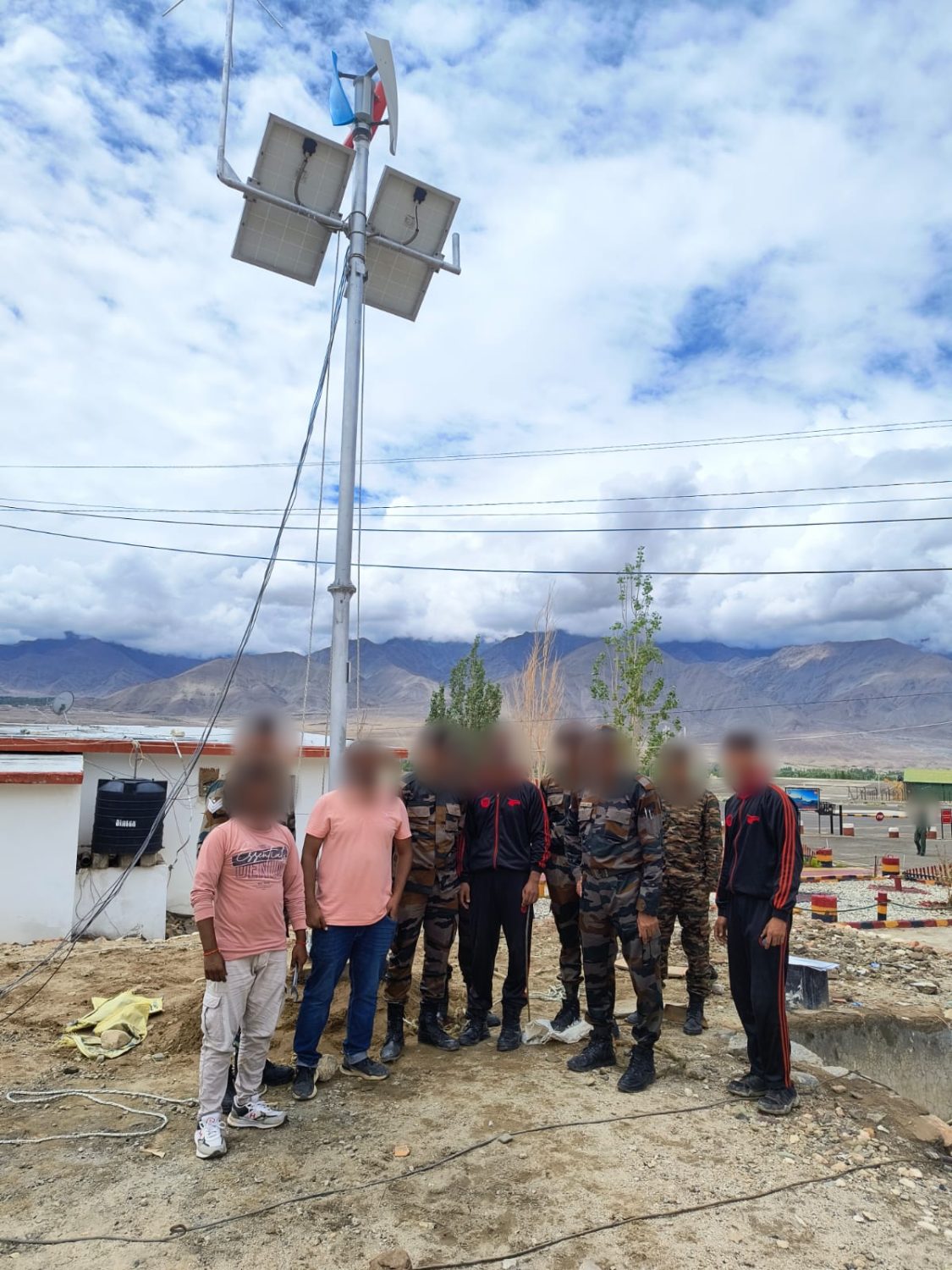 Install
Faces, name tapes, units and locations are obscured or withheld on this public page. Unredacted references and trial reports are released only to verified buyers against a service letter.
How to evaluate & procure.
A typical defence procurement runs four phases. We support each one.
Unit Brief
Capability walk-through at your unit, with a 6-radio loaner mesh issued for you to run in your own terrain.
Trial Deployment
20–30 day field trial with a section-strength kit, channel-keyed for your unit and supported by our engineer on call.
Procurement
Full kit ordered against unit indent. We integrate, key, ATAK-load and crate against the agreed specification; lead time is 4–8 weeks depending on quantity, with no development phase in front of it.
Sustainment
Annual firmware updates, spares pool, refresher training. AMC available with 24-hour-replacement guarantee for forward locations.